skip to main |
skip to sidebar
 I haven't loved all of Rick Moody's books, but The Ice Storm, Demonology , and this book are favorites of mine. (Well, maybe "favorite" is a strong word, so I'll just say "well-liked books.") The black veil of the title refers to the Nathaniel Hawthorne story "The Minister's Black Veil," which is based on the true story of a clergyman who Moody believes may be a distant relative. Partly a quest to research Hawthorne and his possible ancestor, but moreso an account of the author's personal relationship to the story of the black veil.
 It is designed to look like an old decaying antique book, the cover of which has been torn off, which, while perhaps not all that original, is nonetheless appealing to me.
My mother, who is a pharmacist, moved out of her house a few years ago and during that time she was constantly asking me to look through boxes of things she no longer wanted, just in case they were of interest to me. (Well, actually, it is still going on as she is now cleaning out her storage space--there is a never-ending supply of boxes of things to go through.) In one of those boxes, I uncovered a copy of this 1926 reference book on plants and their medical uses. The book was published in 1926 and was once owned by a man named Philip Willcott (or so the name written on the inside front cover says).
 In addition to the interesting photos of plants, what most attracted me to the book were the many handwritten notes (written in by Mr. Willcott, I will assume).
 The note on the bottom left page is pretty great: "Death by asphyxiation, Insanity, Melancholia". In other words, stay away from Stramonium! (For more on the hallucinogenic effects of this plant, check out the wikipedia page.)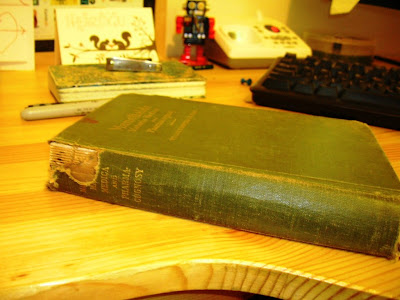
 Joan Didion is one of my favorite writers. Everything she does is magnificent, including this novel of a Hollywood actress who drifts through life with a detachment that is startlingly bleak. It is stunning and depressing.
 This book is a kind of companion piece to Bill Daniel's documentary Who Is Bozo Texino?, in the form of a rail zine (purporting to be published in April 1908). Shot on Super-8 and 16mm film over a 16-year period in which Daniel rode the freights, the film chronicles the search for the source of a drawing seen on railcars for more than 80 years.
 While some of the book is a direct transcript from the movie, there are also many great extras, including interviews, newspaper articles, photos, maps, and illustrations from such artists as Barry McGee and Margaret Kilgallen.
 I love these rail map end papers.
 An article about one of the men behind the mystery, the original Bozo Texino.
 A little bit about Herby, perhaps one of my favorite hobo tags.
 The book includes a variety of ads, some of them real, but there are also some great fake ones promoting products like "The Hobo's Wife."
 All in all, it's a beautiful looking package with some fascinating hobo lore and ephemera.

 I haven't loved all of Rick Moody's books, but The Ice Storm, Demonology , and this book are favorites of mine. (Well, maybe "favorite" is a strong word, so I'll just say "well-liked books.") The black veil of the title refers to the Nathaniel Hawthorne story "The Minister's Black Veil," which is based on the true story of a clergyman who Moody believes may be a distant relative. Partly a quest to research Hawthorne and his possible ancestor, but moreso an account of the author's personal relationship to the story of the black veil.
 It is designed to look like an old decaying antique book, the cover of which has been torn off, which, while perhaps not all that original, is nonetheless appealing to me.


